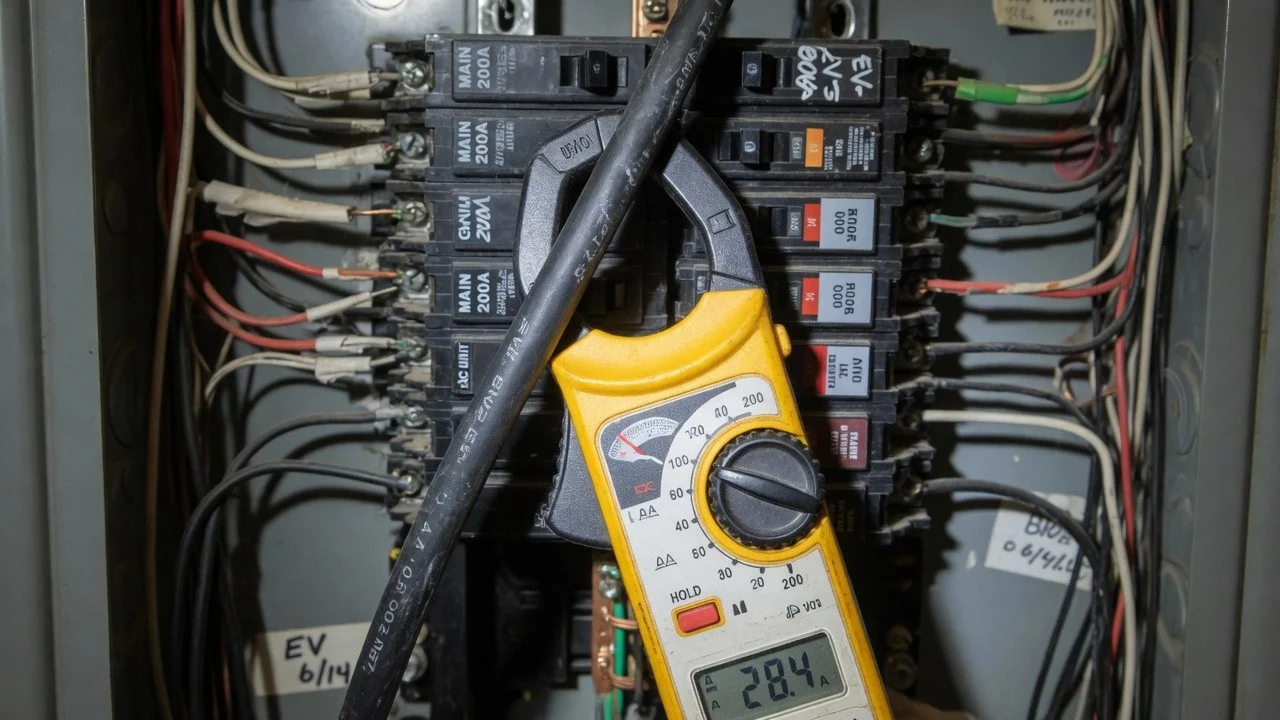
People shop amps like phone storage: more feels safer. On a home electrical panel, more is not always smarter.

Short answer: A 40-amp EV charger circuit is a strong default for many USA homes. A 48-amp continuous design (often on a 60-amp breaker) can charge faster when the car and panel both support it. The right choice is the highest amperage your car’s onboard AC charger can use and your panel can support safely—not the biggest number on a product box.
Why this keyword is full of half-answers
Many pages paste a spec table and say “48A is better.” They skip the continuous-load rule, the car’s real AC limit, and the moment higher amps force a panel upgrade that costs more than years of slightly faster overnight fills.
The 80% continuous load rule in plain English
EV charging often runs for hours. Electrical planning treats that as a continuous load. A common design approach is that continuous load should stay near 80% of breaker rating.
| Continuous charge current (approx) | Common breaker sizing approach | Rough power at 240V |
|---|---|---|
| 32A | 40A breaker class designs are common | About 7.7 kW |
| 40A | 50A breaker class designs are common | About 9.6 kW |
| 48A | 60A breaker class designs are common | About 11.5 kW |
Exact design must follow current NEC rules as adopted by your city and the manufacturer instructions. This table is a learning map for conversations with your electrician—not a DIY wiring chart.
Your car may not use 48A AC
The wall unit can offer high current. The car’s onboard AC charger sets the real ceiling for Level 2 speed. Many EVs sit in the ~7–11 kW class on AC. If your car tops out near 32A or 40A, a 48A-capable wall unit will not magically push more AC into that car.
Check the owner’s manual for “AC charging,” “onboard charger,” or max kW on Level 2. That one number saves bad shopping.
40-amp: when it is the smart pick
- Your car’s AC limit is at or under the 40A continuous neighborhood.
- Your panel has limited spare capacity.
- You park 8–12 hours overnight and do not need maximum speed.
- You want a simpler path to permit and pass inspection without a service upgrade.
- You are planning two EVs later and want headroom for a second circuit or power sharing.
For many households, 40A continuous on a proper circuit already turns “will it be ready?” anxiety into boring overnight charging.
48-amp: when it earns its keep
- Your car can accept the higher AC rate.
- Your electrician confirms the panel and wire path support a 60A-class circuit design.
- You often have short overnight windows (shift work, late returns).
- You regularly recover from long days or road trips at home.
- You prefer one faster circuit now and understand the install cost tradeoff.
Faster AC still is not DC fast charging. Do not buy 48A expecting Supercharger-like fills at home.
Time difference honesty
On a large battery, 40A vs 48A can matter. On a medium daily top-off, both often finish long before morning. Example thinking (simplified):
- Need about 40 kWh overnight.
- At ~9.6 kW (40A class), roughly 4+ hours of charging time.
- At ~11.5 kW (48A class), roughly 3.5 hours class time.
If the car sits from 8 p.m. to 7 a.m., both schedules usually win. If the car sits from midnight to 6 a.m. after a long day, higher power can matter. For full charge-time math, see how long to charge an EV at home.
Install cost impact
The wall unit price gap between 40A and 48A models is often smaller than the electrical work gap. Higher continuous current can mean larger wire, different breaker design, and more pressure on panel capacity. If 48A forces a service upgrade you could have avoided with 40A plus good scheduling, the “faster” choice can cost thousands. Cross-check install cost ranges.
Two-EV homes
Two high-amp circuits can light up a panel capacity problem fast. Options include:
- Two moderate circuits if the panel allows.
- One high-amp circuit with disciplined sharing (not ideal for two drivers).
- Power-sharing EVSE systems that throttle combined load.
- Staggered schedules (one car finishes before the other starts heavy draw).
Bring the second-car timeline to the electrician on day one.
Common mistakes
- Buying 48A because a YouTube list said “best.”
- Ignoring the continuous load / breaker relationship.
- Assuming a dryer circuit can be shared forever.
- Setting the wall unit to max amps when the panel is already stressed.
- Forgetting that cold weather and preconditioning change overnight energy need more than a 8A difference sometimes does.
Simple chooser
| If this is true… | Start here |
|---|---|
| Car AC limit ≤ ~32–40A, long nights, tight panel | 40A class design |
| Car can take ~48A, healthy panel, short nights | 48A class design |
| Not sure about car limit | Read the manual, then choose |
| Panel borderline | Ask about 40A + load management before upgrade |
| Second EV in 12–24 months | Design for sharing, not max one circuit ego |
Breaker, wire, and wall unit: three different “amp” words
People mix three numbers: the breaker handle rating, the continuous charge current, and the marketing number on the box. Your electrician designs the circuit. The car consumes what it can. The wall unit offers a maximum and may let you set a lower limit in software.
When you talk to pros, say “I want about X amps continuous to the car” rather than only “I bought a 48-amp charger.”
Panel headroom checklist
- Service size (often 100A, 150A, 200A class homes)
- Existing large loads: HVAC, range, dryer, spa, well pump
- EV future #2
- Electrification plans (induction, heat pump) in the next 5 years
If several of those collide, a moderate EV circuit plus load management can be wiser than maxing one branch.
Software amp limits: useful tool, not a free pass
Many units let you dial amps down. That helps share capacity and reduce heat on marginal days. It does not mean you can ignore manufacturer circuit requirements when installing. Install to the instructions, then configure for daily life.
When “faster” is the wrong optimization
If you are home 11 hours every night and use 15 kWh, both 40A and 48A finish early. Optimize for install cost, noise in the panel, and second-car readiness. Speed only becomes the main KPI when the car is home briefly or daily kWh is huge.
Talk track for sales pressure
If a seller pushes the highest amp model without asking about overnight hours or onboard limits, slow down. Ask for the car’s AC max and a load calculation path. You are shopping a home system, not a drag-strip accessory.
NEC continuous load concept without fear language
Long charge sessions heat conductors more than short bursts. That is why continuous load design uses conservative fractions of breaker ratings. You do not need to recite code tables. You need an electrician who designs for continuous EV load instead of treating the circuit like a rarely used tool outlet.
PHEV vs BEV amp needs
Plug-in hybrids often need less daily kWh than big battery EVs. A moderate circuit can be perfect. Do not let a BEV marketing chart force a 48A install for a PHEV that only sips overnight.
Setting daily amps after a correct install
Install to the design. Then, if the unit allows, set a daily amp limit that matches household load comfort. Big dinner + HVAC + max EV draw is a real-world stack. Adjusting software amps is normal; redesigning wire after the fact is not.
FAQ
Is 48-amp always faster than 40-amp?
Only if the car accepts the extra current. Otherwise both charge at the car’s limit.
Can I install a 48A unit and software-limit it to 32A or 40A?
Many units allow amp limits in settings. That can be useful, but the circuit still must be installed to the manufacturer and code requirements for the unit’s rating and configuration. Ask the electrician; do not guess.
What about 80-amp wall units?
Some products advertise very high amps. Most homes and cars never need that on AC. Higher designs put more stress on service capacity and cost.
Does higher amp charging hurt the battery?
Normal Level 2 AC within the car’s limits is standard daily behavior. Follow the car maker’s daily charge recommendations (often a charge limit under 100% for everyday use).
What should I buy after I pick amps?
Use the 2026 buying guide, then get install quotes with a clear amp target.
Educational guide for USA homes. Final circuit design belongs to a licensed electrician following local code and manufacturer instructions.
Related guides: buying guide, install cost, charge time.