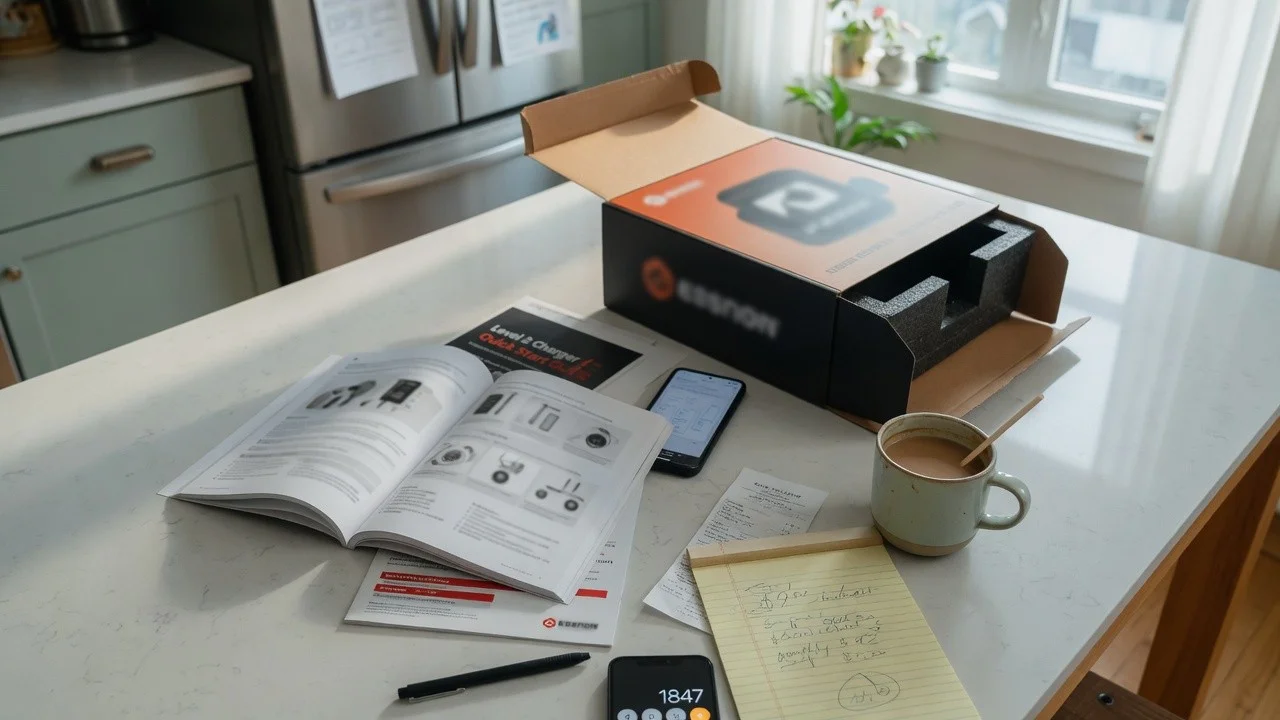
You want a number you can put in a spreadsheet. Installers want to see your panel photo first. Both sides are right—and that is why “average cost” pages frustrate people.

Short answer for many USA homes in 2026: a simple Level 2 project often lands near $1,000 to $2,700 total (charger unit + labor + basic materials + permit). Easy garage jobs near a healthy panel can come in lower. Long runs, outdoor trenches, or service upgrades can push the project past $4,000 to $7,000+. Treat every national range as a planning band, then get two or three local quotes.
Why competitor “one number” pages mislead
Many cost articles publish one average and stop. Real bids move with four things: panel capacity, wire distance, mounting location, and local labor/permit culture. Two neighbors can get quotes $2,000 apart for the “same” charger model.
This guide gives you a three-tier job model and a line-item builder so you can spot a fair quote—not memorize a fake single price.
Three job tiers (use these when you call electricians)
| Tier | What the job looks like | Planning total (unit + install) |
|---|---|---|
| Simple | Panel in garage, short run, spare capacity, indoor wall unit | About $800–$1,800 |
| Typical | Moderate run, outdoor disconnect or longer conduit, permit, solid 40–48A circuit | About $1,500–$3,200 |
| Complex | Panel upgrade/subpanel, trench, difficult walls, long outdoor path, older service | About $3,500–$7,000+ |
Hardware alone for a reputable Level 2 unit often sits near $300 to $800. Labor and electrical materials usually decide whether you are in the simple tier or not.
Line-item budget builder
| Line item | Common planning range | What moves it |
|---|---|---|
| Charger unit | $300–$800 | Amps, cable length, smart features, NACS vs J1772 |
| Labor | $500–$1,800+ | Hours, access, crew rates, troubleshooting old wiring |
| Wire, conduit, breaker, disconnect | $150–$600+ | Distance, indoor vs outdoor, copper size |
| Permit + inspection | $50–$300+ | City rules; some places cost more |
| Panel upgrade (if needed) | $1,500–$5,000+ | Service size, utility fees, main breaker work |
| Trench / long outdoor path | $500–$2,500+ | Length, concrete, landscape restore |
Print this table. Ask each bidder to map their number onto these lines. Vague single-line quotes are harder to compare.
What actually drives Level 2 install cost
1. Distance from panel to parking spot
Feet of copper and conduit are not free. A wall unit ten feet from the panel is a different job than a driveway pedestal eighty feet away through finished space or soil.
2. Panel capacity and load calculation
Many homes can add a 40-amp or 50-amp branch circuit without a full service upgrade. Some cannot. A licensed electrician should run a load calculation—not guess from a glance. Load management hardware can sometimes avoid a full panel replacement. That option is under-explained on thin cost blogs.
3. Indoor garage vs outdoor mount
Outdoor work needs weather-rated gear, often more conduit, and careful GFCI / disconnect planning. Coastal salt air and desert heat both change hardware choices.
4. Plug-in NEMA outlet vs hardwired unit
A NEMA 14-50 style outlet project and a hardwired wall connector are related but not identical scopes. Plug-in can help renters or people who may move the charger later. Hardwired is common for clean permanent installs. Your electrician should design for code, not only for Amazon convenience.
5. City permits and utility rules
Permit cost is usually small compared with labor, but skipped permits can become a sale-time problem. Some utilities also offer rebates that require licensed install and paperwork. Read our tax credit and rebates guide before you assume incentives will cut the bid.
State flavor (without pretending every city is equal)
National bands still need local eyes:
- California install cost notes — high labor markets, outdoor heat, dense cities
- Texas install cost notes — big metro vs suburbs, heat, long garage runs
- Florida install cost notes — humidity, outdoor enclosures, HOA garage patterns
How to get quotes that you can compare
- Photograph the panel label, open breaker map, and the parking wall.
- Measure approximate feet from panel to charger location (and note finished walls).
- Tell bidders your car’s onboard AC charge limit if you know it.
- Ask for a written scope: breaker size, wire size, disconnect, permit, and whether the unit is hardwired or plug-in.
- Get at least two bids. Three is better when the first number shocks you.
Quote red flags
- Refuses permits in a city that clearly requires them.
- Quotes a high-amp circuit without talking about continuous load or panel math.
- Pushes the most expensive unit without asking about daily miles or second EV plans.
- Cash-only, no invoice, no license number.
- Guarantees a federal tax credit dollar amount without telling you to verify current IRS rules.
Ways to lower cost without cutting safety
- Mount closer to the panel when parking allows.
- Choose a solid mid-amp design if your car cannot use 48A AC anyway.
- Ask about load management before you approve a full service upgrade.
- Confirm utility rebates and manufacturer discounts before the crew orders materials.
- Do homeowner prep (clear wall, attic access, pets secured) so labor hours stay honest.
Do not “save money” with undersized wire, shared dryer hacks, or unpermitted work you will regret at inspection or home sale.
Sample budgets you can sanity-check against
Example A — simple garage: $450 unit + $900 labor/materials + $100 permit ≈ $1,450.
Example B — longer outdoor run: $600 unit + $1,800 labor/materials + $150 permit ≈ $2,550.
Example C — panel work: $550 unit + $1,200 charger circuit + $3,200 panel upgrade ≈ $4,950.
Your numbers will differ. The point is structure, not prophecy.
Permit, inspection, and “soft costs”
Soft costs are easy to forget in a spreadsheet. Permit fees, inspection rework, HOA applications, rental of lifts for high mounts, drywall patch after fishing cable, and landscape repair after a trench all count. A bid that looks cheap until those appear is not actually cheap.
Ask: “What is excluded?” If the answer is fuzzy, get it in writing.
Load calculation vs “panel looks full”
A panel can look crowded with breakers and still have service capacity—or look neat and still fail a load calculation. The professional calculation is the filter. Load management hardware (EVSE that shares power with other loads or between cars) is sometimes a better spend than a full service upgrade. Ask for both prices when capacity is tight.
Materials quality without becoming a parts geek
You do not need to specify every lug. You should still ask that outdoor work uses outdoor-rated materials, that wire sizing matches continuous load design, and that the disconnect (when required) is placed where code and the manufacturer expect. Cheap corners on weather seals become callbacks.
After the install: what still costs money
- Utility rate plan changes (sometimes save money, sometimes not)
- Replacement cables or connectors years later
- A second circuit when EV number two arrives
- HOA re-approval if you move exterior equipment
Budget a small contingency (even 10%) on complex jobs so a buried surprise does not stall inspection.
Comparing three bids fairly
Make a one-page grid: breaker size, wire approach, hardwired vs plug-in, permit, timeline, warranty on labor, exclusions. Rank safety and clarity above a $150 hardware difference. The lowest number is not automatically the best electrical design.
Change-order triggers to ask about up front
- Knob-and-tube or aluminum branch surprises
- Full garage drywall fish instead of surface conduit
- Main breaker replacement not visible in first photo set
- City requiring a different disconnect location
Good bids name what happens if these appear. Vague bids become expensive stories.
FAQ
Is $500 total realistic?
Sometimes for a very short indoor run when you already own the unit and the panel is easy—and labor is priced that way in your area. Treat it as a best case, not the plan.
Does a 48-amp charger always cost more to install than 40-amp?
Often the circuit and wire design change. The bigger jump is when the higher load forces panel work. Read 40-amp vs 48-amp.
Should I buy the charger before hiring an electrician?
You can shortlist models, but confirm hardwired vs plug-in and amperage with the electrician first so you do not buy the wrong unit.
Will the federal tax credit pay for half my project?
Do not budget that way until you verify current eligibility, caps, and your tax situation. Rules change. Use IRS sources and a tax pro.
What is the next step after I accept a quote?
Follow a clear install sequence: scope, permit, install, inspection, then first charge. See how to install a home EV charger.
Planning ranges for USA readers, 2026. Not a bid. Local labor, code, and utility rules control the final number. Hire licensed pros for electrical work.
Related guides: install steps, California costs, credits & rebates.