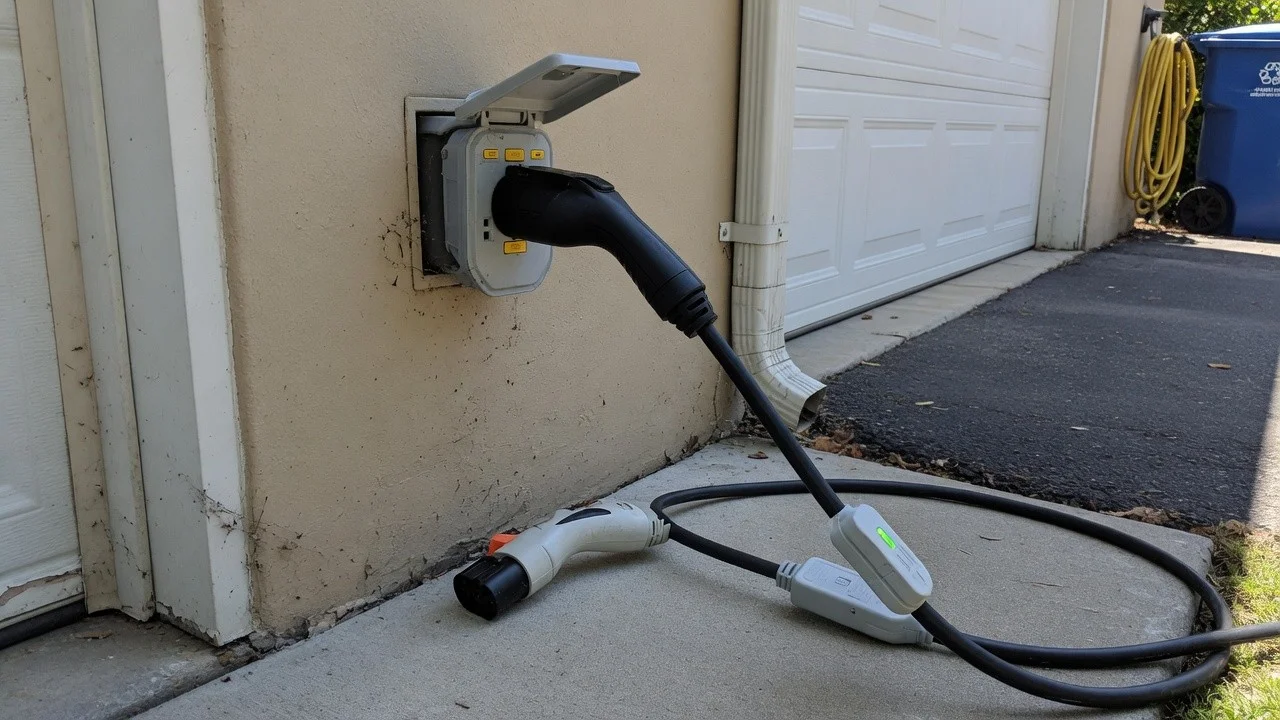
You bought an EV (or you are about to). The first real decision at home is not which brand badge to buy. It is whether the slow cord that came with the car is enough, or whether you need a faster 240-volt setup.

Short answer: Level 1 uses a normal 120-volt outlet and usually adds about 3 to 5 miles of range per hour. Level 2 uses a 240-volt circuit (same voltage family as many dryers) and often adds about 20 to 40+ miles per hour. If you drive more than about 30 to 40 miles most days, or you hate “will it be full by morning?” stress, Level 2 is the better long-term plan for most homes with off-street parking.
What Level 1 and Level 2 actually mean
Level 1 is the portable EVSE (the charging cord and brick) on a regular household receptacle. Level 2 is either a wall-mounted unit or a proper 240-volt outlet setup made for overnight home charging.
Many articles stop at a two-column table and call it done. Useful planning needs more: your daily miles, how long the car can sit, and whether you control the electrical panel.
| Topic | Level 1 | Level 2 |
|---|---|---|
| Power source | 120V outlet | 240V circuit |
| Typical power | About 1.2 to 1.9 kW | About 7 to 11.5+ kW |
| Range per hour | About 3 to 5 miles | About 20 to 40+ miles |
| Gear cost | Often included with the car | Often $300 to $800 for a solid unit |
| Install cost | $0 if the outlet is safe and dedicated enough | Often hundreds to a few thousand for wiring and labor |
| Best for | Low daily miles, short-term, renters waiting on building work | Most homes that park off-street overnight |
Miles per hour change with the car, weather, battery size, and how full the battery already is. Treat the table as a planning tool, not a warranty.
Daily-miles decision matrix (what listicles skip)
Use this as a starting filter before you shop brands.
| Your normal day | Overnight window | First plan to try |
|---|---|---|
| Under ~25 miles | 10+ hours | Level 1 often works |
| 25–40 miles | 8–10 hours | Level 1 may work; Level 2 feels easier |
| 40–70 miles | 8–10 hours | Level 2 for most people |
| 70+ miles or two drivers sharing one car | Irregular | Level 2, and check public backup for busy weeks |
| Any miles, but only 4–5 hours parked | Short | Level 2 (or workplace charging) |
If your “normal” week includes surprise longer days, plan for the busy week, not the quiet Tuesday.
When Level 1 is enough
Level 1 can be a smart first step if you drive a short commute and the car sits for many hours. It is also useful when you rent and cannot open the panel yet.
Keep the portable cord even after you install Level 2. It is a travel tool and a backup if the wall unit is offline.
Watch for these Level 1 failure signs:
- You leave home below the charge level you wanted three or more days a week.
- You start planning public DC stops for ordinary errands.
- You are using a worn outdoor outlet or a crowded kitchen circuit as “the plan.”
- Cold weather cuts range and your overnight recovery never catches up.
When Level 2 is worth the project
Choose Level 2 if you often drive more than about 30 to 40 miles a day, own a larger battery EV, share the car in a two-driver household, or simply want calm mornings.
With Level 2, most people charge the way they used to think about a gas tank: plug in when you get home, leave with a high charge the next day. You use public fast chargers more for road trips than for normal weeks.
The hidden cost of “free” Level 1
Level 1 looks free because the cord came with the car. Time is not free. Neither is a mid-week DC fast charge when the overnight plug never caught up.
Rough way to think about it:
- If Level 1 forces one extra public fast session per week, add that time and fee into your true cost.
- If it forces you to charge at peak utility rates more often, your electricity bill can rise even at home.
- If it delays a second household EV purchase because the first car “never feels ready,” that is a lifestyle cost.
Level 2 costs more up front. In many USA homes, a full simple project (unit + install) often lands near $800 to $2,700. Panel upgrades, long outdoor runs, or trench work cost more. Get local quotes. For national ranges and what drives price, see our Level 2 installation cost guide.
Renter path vs homeowner path
Renters: Start with Level 1 on a safe outlet. Ask about a dedicated outdoor receptacle only if the landlord will allow it and an electrician will install it correctly. Do not DIY open panels in a rental. Document every request in writing.
Homeowners: Price Level 2 as a one-time home upgrade. A short run from a healthy 200-amp panel is a different project than a 100-amp panel with no spare capacity and parking 80 feet away.
Apartment and condo parking is a separate problem set. If you do not control the stall wiring, read our apartment and condo charging guide.
Outlet and circuit safety (skip this and you pay later)
- Do not treat a random outdoor GFCI as a permanent high-load plan without inspection.
- Do not run cheap extension cords for daily charging.
- Do not share a dryer circuit as a long-term Level 2 solution without a licensed design.
- For new 240-volt work, hire a licensed electrician in almost all USA homes.
- Pull permits when your city requires them. Inspections protect you at sale time too.
MaxEvCharge teaches planning. We are not your electrician.
A 10-minute decision checklist
- How many miles do you drive on a normal day? On a busy day?
- How many hours can the car sit plugged in overnight?
- Do you control the electrical panel (own vs rent)?
- Is there a clean path from the panel to where you park?
- Will a second EV arrive in the next 2–3 years?
- Is workplace or overnight street parking part of your week?
If steps 1 and 2 already feel tight on Level 1, start pricing Level 2. If step 3 is “no,” focus on building policy, portable options, and workplace charging before you buy a hardwired unit.
Common myths
“Level 2 ruins the battery.” Daily AC Level 2 charging is normal for modern EVs. Extreme DC fast charging every day is a different habit. Follow your car maker’s guidance on charge limits for daily use.
“I need the highest amp charger.” No. Many homes do fine on a well planned 40-amp circuit. Match the car’s onboard AC limit and your panel space. See 40-amp vs 48-amp.
“Level 3 is home charging.” No. Level 3 usually means public DC fast charging. Homes almost always use Level 1 or Level 2.
Real week scenarios (use these, not vibes)
Scenario A — 18-mile round trip, garage overnight. Level 1 usually works. You may still want Level 2 for weekend trips and cold weeks.
Scenario B — 45-mile commute, home by 7 p.m. Level 2 is the calm default. Level 1 will feel tight if you also run errands.
Scenario C — 70 miles some days, home late. Level 2 plus a workplace plug if available. Level 1 alone becomes a public-charging hobby.
Scenario D — apartment, no stall control. Do not force a hardwired purchase. Build a stack: building stations, work, portable only with permission. See the apartment guide linked below in related reading on the live post.
Electricity cost vs public DC (planning view)
Home energy is usually priced in cents per kWh on your utility bill. Public DC often prices higher per kWh or per minute, plus idle fees. Even when Level 2 install costs money up front, many drivers recover convenience in months—not only dollars.
Rough home energy thought experiment: 30 kWh recovered at $0.15/kWh is about $4.50. The same energy on a pricey DC stall can cost more and burn twenty minutes of your evening. Your rates differ—check your bill.
What to tell an electrician in one paragraph
“I drive about X miles per day. I park at Y. I want Level 2 on a dedicated circuit, probably 40-amp class unless my car needs more and the panel allows it. Here are panel photos and the wall where the cable must reach the charge port.” That paragraph produces better bids than “I need the fastest charger.”
Second EV planning without buying twice
If a second car is likely, say so now. Power sharing, a second circuit later, or a slightly different amp choice can save a panel surprise. Do not install the maximum single-circuit ego design if it blocks car two.
FAQ
Is Level 1 okay for a long-range EV?
It can be, if your daily miles are low and overnight time is long. A large battery does not force Level 2 by itself. Your daily energy use does.
Can I start on Level 1 and upgrade later?
Yes. That is a common path. Keep the portable cord. When you install Level 2, you already know your real daily pattern.
Can a dryer outlet power Level 2?
Sometimes the outlet style looks similar, but sharing dryer use is often a poor long-term plan. Ask an electrician about a dedicated circuit and correct breaker sizing.
Do I need Wi‑Fi on the charger?
Not required to add energy to the car. Smart features help with schedules, utility rates, and power sharing. Buy them if you will use them.
What should I read next?
If you already know you want Level 2, go to the install steps guide or the 2026 buying guide that starts with your panel, not a brand ranking.
Written for USA readers. Local codes and utility rules differ. Verify details with a licensed electrician and your city before you install.
Related guides: install cost, 40 vs 48 amp, charge time math.