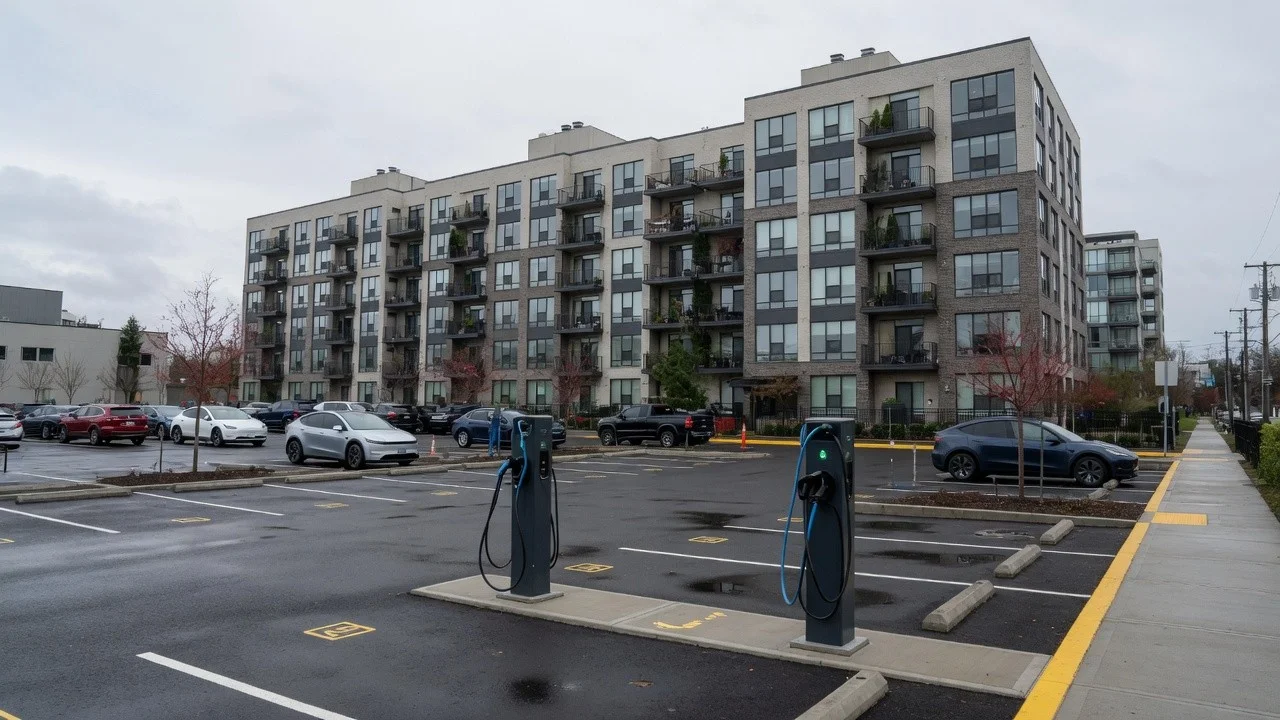
If you own a suburban garage, home charging is an electrical project. If you rent an apartment or live in a condo, it is a politics project first and an electrical project second.

Short answer: Your realistic options are usually: existing building chargers, a deeded/assigned stall with approved wiring, a portable Level 2 plan only if a legal receptacle path exists, workplace charging, and public/network charging as backup. Do not buy a hardwired wall unit until you know who owns the stall, who pays the power, and what the HOA or landlord will approve in writing.
Why generic “ask your landlord” posts fail
They skip ownership maps. A surface lot stall, a deeded garage space, and a first-come courtyard plug are three different legal and billing problems. This guide starts with who controls what.
Stall ownership map
| Situation | Who usually controls wiring | What you can often pursue |
|---|---|---|
| Open lot, unassigned | Property management | Shared station request; policy change |
| Assigned stall, rental | Landlord / owner | Written approval for receptacle or station |
| Deed condo stall | You + HOA common elements rules | HOA application for run across common areas |
| Street parking only | City / none at home | Workplace + public; building advocacy longer term |
| Existing paid stations on site | Operator / property | Access hours, pricing, plug type check |
Option 1 — Use what the building already installed
Before activism, inventory:
- How many plugs and what connector types?
- Assigned vs shared?
- Hour limits and idle fees?
- App payment or fob?
- Reliability history (broken units are common)?
If stations are always full, that is a sizing problem—share how many chargers a complex needs with management.
Option 2 — Request an assigned solution
Bring a calm written packet:
- Your stall number and photos
- Preferred solution (dedicated receptacle vs wall EVSE)
- Who pays electricity (submeter, flat fee, your panel if truly isolated)
- Licensed electrician requirement
- Insurance and removal-on-move-out terms
- Offer to pay reasonable costs if that is your proposal
Ask for a written yes/no with reasons. Verbal hallway approvals evaporate.
Option 3 — Portable Level 2 (with hard limits)
Portable Level 2 is not a magic override of building policy. It still needs a correct 240-volt receptacle plan and permission. A random outdoor outlet on a shared circuit is not a plan. Safety and fire codes apply in multi-unit buildings for good reason.
Option 4 — Workplace + public stack
Many apartment drivers survive with:
- Workplace Level 2 during the day
- Occasional public DC for long weeks
- Building charging when available
Calculate whether this stack costs more time and money than pressing for an assigned home stall. Use charge time math with your real weekly miles.
HOA and “right to charge” reality
Some states and cities have rules that limit blanket bans on EV charging. Details differ a lot. Do not claim a universal federal right that forces free installation on any HOA. Read your state language, your CC&Rs, and get local advice when money is large.
Boards still care about:
- Common area penetrations
- Fire safety
- Fair access if others want the same
- Who pays for electricity and maintenance
Billing models you may hear
| Model | Idea | Watch-outs |
|---|---|---|
| Resident-paid install | You fund the station at your stall | Removal rules; resale of equipment |
| Property-owned shared | Building installs a pool of chargers | Queueing; idle fees needed |
| Third-party operator | Vendor installs/operates | Contract length; pricing; uptime SLAs |
| Flat monthly fee | Simple billing | Can be unfair to light users |
| Per-kWh | Pay for energy used | Needs metering and clear rates |
For board-level operator vs ownership tradeoffs, see zero-cost vs owned charging.
What not to do
- Run extension cords across walkways as a permanent system
- Tap a neighbor’s outlet without formal agreement
- Install into common conduits without approval
- Assume Tesla or any brand wall unit is allowed because you own the car
- Start construction before written approval and insurance answers
A 30-day action plan for residents
- Week 1: Map existing charging and document busy times with photos/notes.
- Week 2: Talk to neighbors who also want charging—numbers help boards.
- Week 3: Submit a written proposal with options at different price points.
- Week 4: If denied, ask what conditions would make approval possible; escalate politely with policy references where real.
Sample outline for a written request (customize it)
- Who you are and your unit/stall number
- Why you need reliable overnight charging (commute miles)
- Two or three solution options at different cost levels
- Commitment to licensed electrical work and permits
- Proposal for electricity payment method
- Offer to remove equipment on move-out if required
- Request for written decision timeline
Attach photos. Boards respond better to complete packets than to lobby complaints.
Insurance and liability questions to raise early
Who is insured if a station is damaged? If a cable causes a trip injury? If a DIY attempt causes a fire claim? Properties take these seriously—bring them up before they become the reason for a denial.
Measuring building demand without fancy software
For two weeks, note how often existing chargers are busy at 7 p.m. and 7 a.m. Count unique cars. That mini study is gold in a management meeting and pairs well with the complex sizing guide.
Moving in or renewing a lease
Ask EV questions before you sign: stall type, existing chargers, upgrade policy, any EV fee. Getting surprise “no charging ever” after you already own the car is a painful way to learn.
Neighbor diplomacy
Find two other interested residents before the big ask. A trio with written interest looks like demand. One person looks like a special request. Stay factual; skip car-brand wars in the group chat.
Fire safety conversations that stay calm
Property teams worry about batteries and cords. Meet them with licensed electrician requirements, listed equipment, and no-hallway-cord policies. Safety seriousness builds trust; dismissing concerns stalls projects.
Submetering basics
If power cannot come from your unit panel, expect a submeter, allocation formula, or flat fee debate. Push for transparency. Unclear electricity money poisons otherwise good hardware plans.
If you are moving out soon
Do not fund permanent infrastructure you must abandon without a written buyback or removal plan. Portable strategies and workplace charging may fit a short remaining lease better.
Documentation that helps when staff turns over
Property managers change. Keep email threads, approval letters, stall maps, and electrician invoices in cloud storage. A new manager who “never heard of your deal” is common. Paper (or PDF) wins arguments that memory loses.
Who pays for power — five models in plain English
| Model | How it feels to you | Main risk |
|---|---|---|
| Your unit meter | Cleanest fairness | Only works if wiring path is truly yours |
| Submeter at stall | Pay for what you use | Install complexity |
| Flat monthly EV fee | Simple bill | Light users overpay |
| Network per-kWh price | App checkout | Price changes over time |
| “Included” marketing | Easy pitch | Costs hide in rent |
Letter packet: what to attach
- Stall photo and map pin
- Two solution options (shared station vs assigned receptacle)
- Note that work will be licensed + permitted if required
- Offer on removal at move-out if you fund hardware
- Quiet hours / cable management promise
- Neighbors’ short interest list if you have one
Managers respond to complete packets. Hallway complaints without paper die in the inbox.
If the answer is “not now”
Ask what would make “yes” possible: different stall, resident-paid model, HOA template, or a building-wide pilot. Get the conditions in writing. Then run a 90-day personal stack: workplace charging, scheduled public sessions, and trip planning so you are not stranded while policy moves slowly.
Condo purchase diligence (before you close)
Make EV charging a checklist item with parking. Ask for HOA EV policy, any pending special assessments for electrical work, existing station uptime, and whether exclusive-use stalls can host resident equipment. Surprises after closing are expensive emotionally and financially.
Boards comparing vendors can use zero-cost vs owned and how many chargers.
FAQ
Can my landlord refuse all charging?
Sometimes yes, sometimes local rules limit blanket bans. Get the refusal in writing and check local law. This is not one-size-fits-all legal advice.
Who pays for the electricity?
That must be defined: your meter, a submeter, a flat fee, or an operator’s network pricing. Undefined power is how disputes start.
Is Level 1 on a hallway outlet okay?
Usually no for shared indoor outlets not designed for continuous EV loads. Safety and building rules come first.
Should I buy a wall connector now?
Not before approval and a licensed design. Hardware is the easy part.
What if I am buying a condo?
Make EV charging part of inspection questions: stall deed language, HOA EV policy, existing infrastructure, and any pending assessments.
USA renter and condo education. Not legal advice. Building rules and state laws differ—verify before you install or wire anything.