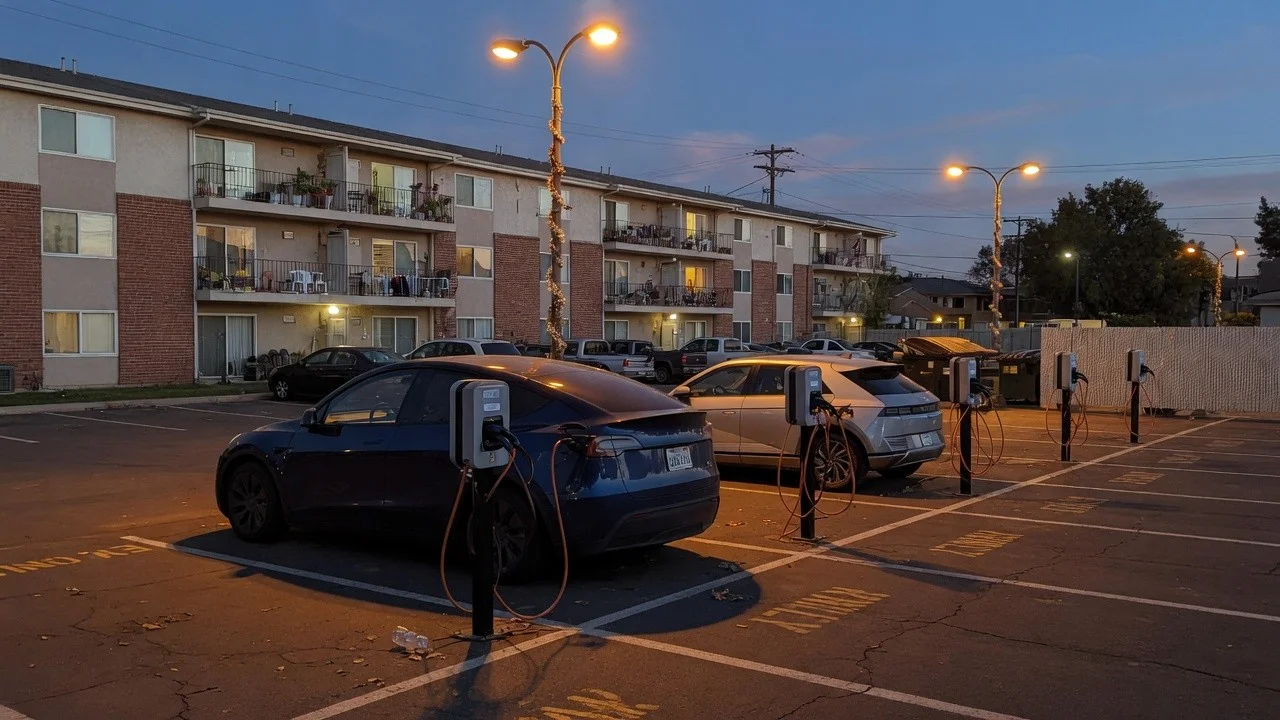
Property managers ask for a single ratio: “chargers per unit.” Vendors sometimes answer with a sales package. Both miss the real inputs: how many EVs exist today, how residents park, and whether stations are shared or assigned.

Short answer: There is no universal magic number. A practical starting frame for many USA multifamily properties is to size for current EV demand plus near-term growth, using a mix of shared Level 2 stations and clear turnover rules—not one reserved plug per apartment on day one. Load management often lets you serve more drivers with fewer full-power circuits. Phase the build so you learn real usage before you pour concrete twice.
What operator blogs optimize for (and what education sites should do)
Operator sites optimize for signed assessments. Education sites should give boards a sizing method they can take to any vendor. This page is the method.
Inputs you need before counting plugs
- Number of residential units and parking stalls
- Assigned vs open parking
- Current EV and PHEV count (survey beats guessing)
- Workplace charging availability nearby
- Electrical service capacity and future electrification plans
- Whether goal is amenity marketing, resident retention, or code readiness
Shared vs assigned changes the math
| Model | What it means | Sizing implication |
|---|---|---|
| Assigned stall + private EVSE | One driver controls one plug | More hardware per active EV; simpler daily access |
| Shared lot stations | Many drivers rotate through fewer plugs | Fewer plugs can serve more EVs with time limits |
| Hybrid | Some deeded installs + a shared pool | Common end state for mixed buildings |
If parking is open and competitive, shared stations without idle fees become camping spots. Policy is part of capacity.
Starter ratio thinking (not a code table)
Use ranges as conversation starters, then validate with a survey and electrical study:
| Property signal | Shared L2 starting conversation | Notes |
|---|---|---|
| Low EV count today, future-proofing | A small shared bank (for example a few stations) + make-ready conduit | Learn demand before overbuilding |
| Moderate EV adoption, open parking | Enough shared plugs that a typical resident can access several nights a week | Idle fees + time limits required |
| High EV adoption, assigned stalls | Path for resident-paid private installs + some visitor/shared | HOA process matters as much as count |
| Workplace-heavy residents | Fewer overnight plugs may work | Survey commute patterns |
Boards that install zero and wait for “later” often face emergency demand with no conduit. Make-ready pathways are cheaper during other parking projects.
Load management multiplies effective capacity
Eight nameplate 40A circuits are not the same electrical project as eight continuously full loads. Managed systems can share a feeder and throttle when many cars plug in at 6:30 p.m. That can cut service upgrade cost while still finishing charges overnight for typical daily miles.
Ask vendors for:
- Minimum feeder design
- Behavior when stations are fully occupied
- Data access for the property
- Who services failed units
Phased plan boards can approve
- Phase 0 — Survey + electrical study (30 days)
- Phase 1 — Make-ready conduit/raceway in priority parking areas during other work
- Phase 2 — Pilot shared stations in the highest-demand zone with clear rules
- Phase 3 — Expand using utilization data (sessions per day, queue complaints)
- Phase 4 — Private stall pathway with written standards for resident-funded units
This beats a one-shot “cover the whole lot” proposal that dies in budget review.
Policy is capacity
- Time limits for shared stalls
- Idle fees after charge complete
- Towing rules for ICE vehicles blocking EV stalls
- Guest charging rules
- Maintenance response targets
- Transparent pricing if paid
A broken station is a station that does not exist. Uptime deserves a line in the contract.
Ownership models change how many you install first
If a third party funds hardware for revenue share, the first install count may follow their utilization model. If the property owns the network, capital and grant timing dominate. Compare models in zero-cost vs owned. Resident education context: apartment charging options.
Common sizing mistakes
- One charger per unit on day one with no electrical study
- Shared plugs with no idle policy
- Ignoring connector types (NACS/J1772 mix)
- Counting only residents and forgetting fleet/guest demand
- Installing all stations in the farthest low-traffic corner because trenching was cheap there
Utilization metrics that matter after install
| Metric | Why track it |
|---|---|
| Sessions per day | Basic demand |
| Unique drivers per week | Breadth vs a few power users |
| Average kWh per session | Energy vs parking-only behavior |
| Peak queue length | Need for more plugs or stricter limits |
| Downtime hours | Vendor SLA performance |
| Idle fee events | Whether policy is working |
Make-ready vs energized stalls
Make-ready means conduit, pull space, and panel capacity planning so future stations install faster. Energized means live hardware today. Smart capital plans buy make-ready widely and energize in phases based on data.
Visitor and service vehicle demand
Delivery EVs, guest cars, and maintenance vehicles can surprise a design that only counted residents. If your property markets to visitors, include at least a small public-access or guest policy.
Accessibility and placement quality
Stations hidden in unlit corners get low use and more safety issues. Prioritize lighting, camera coverage if appropriate, accessible routes, and stall widths that work with cables. Count usable stations, not only mounted boxes.
Sample board motion language (non-legal template)
“Authorize Phase 1 electrical study and pilot of N shared Level 2 stations in Lot B, with idle-fee policy, 12-month utilization review, and no exclusivity term longer than the pilot without a separate vote.” Have counsel review before use.
PHEV vs BEV mix on property surveys
PHEVs may occupy a stall for a shorter energy session but still block the plug. Count plugs as time resources, not only kWh resources. A survey that only asks “Do you own an EV?” is incomplete—ask miles and whether they have workplace charging.
Night vs daytime occupancy
Some properties empty during workdays. Daytime public or employee charging can monetize hardware, but it can also block residents returning at 6 p.m. Policy design must state who has priority.
Expansion triggers
Predefine triggers: e.g., average evening queue above N cars, or unique weekly users above X for four weeks. Data triggers beat loudest-resident triggers.
Make-ready cost vs energized cost (board math)
Make-ready (conduit, capacity planning) during a garage remodel can be modest compared with later concrete cuts. Energized stations add hardware, networking, and O&M. Separate those budget lines so a “chargers are expensive” debate does not kill the cheaper future-proofing step.
Worked sizing example (illustrative)
Imagine a 120-unit property with 140 stalls, open parking, and a survey showing 18 EVs today plus 10 shoppers planning an EV within a year. Workplace charging is common for half the residents.
| Step | Example thinking |
|---|---|
| Active near-term drivers | ~25–30 people who will want overnight access |
| Shared utilization | Not everyone plugs every night; some top up elsewhere |
| Pilot bank | Start with a visible shared set (policy + idle fees) rather than 30 private stalls |
| Make-ready | Conduit to two more zones during other garage work |
| Review at 90 days | Expand only if queues and unique users justify it |
Your numbers differ. The method matters more than copying this example.
Idle fees are capacity tools
Without idle rules, a finished car can block a plug all morning. That turns four stations into two. Capacity planning without policy is half a plan. Publish rules where residents actually see them—app, email, and signage.
Electrical study questions for the engineer
- What feeder capacity is available without service drama?
- Where does load management change station count?
- Which stalls minimize trenching and maximize use?
- What expansion path avoids ripping finished work twice?
Resident communication timeline
- Announce survey and why it matters.
- Share pilot location and rules before energizing.
- Publish how to start a session and report failures.
- Report 90-day utilization in plain language.
Quiet launches create conspiracy theories. Clear launches create patience.
FAQ
Is there a legal minimum number of chargers?
Some jurisdictions add EV-ready requirements for new construction or major remodels. Existing buildings vary. Check local code and your AHJ—do not rely on a national blog for a mandate claim.
Do PHEVs count like full EVs?
They use less energy per day often, but they still occupy plugs. Survey both.
Should every stall be EV-ready?
Make-ready for many stalls can be smart during repaving or garage work. Energizing every stall on day one is a different budget.
How do we know Phase 1 worked?
Track sessions, unique users, average kWh, peak queue times, and ticket volume for failures.
Where should residents start if management is inactive?
Use the resident playbook in our apartment and condo guide and bring a group request with data.
Educational sizing framework for USA multifamily properties. Not an engineering stamp. Hire licensed electrical and, when needed, EV infrastructure consultants for final designs.