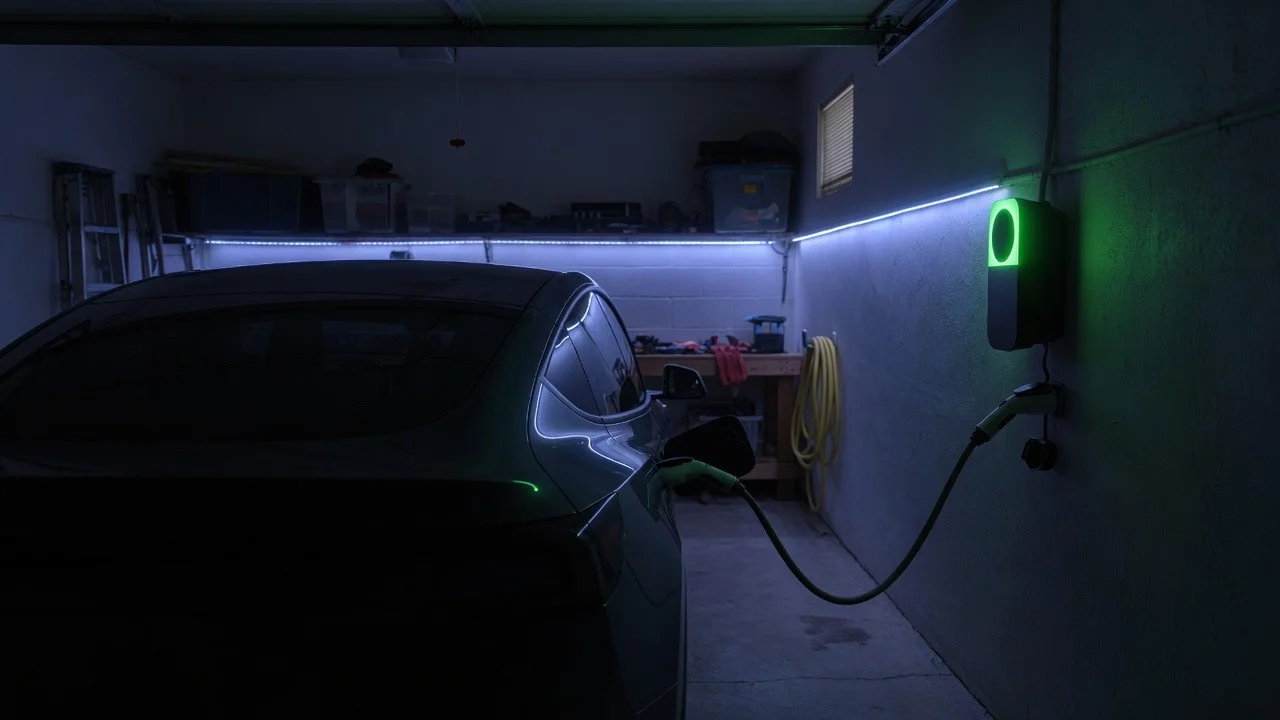
People ask “how long to charge” as if every EV has one timer. Real answers need three numbers: how empty the battery is, how much power the home circuit delivers, and how much the car will accept.

Short answer: On Level 1 (120V), many cars add about 3–5 miles of range per hour, so a big top-up can take overnight or longer. On Level 2 (240V), many homes add about 20–40+ miles per hour, so a normal daily recharge often finishes in a few hours. Use kWh math below for your car instead of memorizing one internet average.
The simple formula (good enough for planning)
Hours ≈ kWh needed ÷ charge power (kW)
kWh needed is not always the full battery. If you used 30% of a 75 kWh pack, you need about 22–23 kWh back—not 75.
Charge power is limited by the slower of: wall circuit, EVSE setting, or car onboard AC charger.
Why thin calculators feel wrong
They assume empty-to-full, ideal temperature, and that the wall unit’s max amps equal the car’s AC limit. Real life includes preheating, winter range loss, and tapering near full. This page uses worked examples and honest ranges.
Level 1 vs Level 2 time intuition
| Setup | Rough power | Rough range per hour | Typical use |
|---|---|---|---|
| Level 1 ~12A on 120V | ~1.4 kW | ~3–4 miles | Low daily miles |
| Level 1 higher 120V settings | ~1.7–1.9 kW | ~4–5 miles | Still slow for big days |
| Level 2 ~32A | ~7.7 kW | ~20–30 miles class | Common solid home rate |
| Level 2 ~40A continuous class | ~9.6 kW | ~25–35+ miles class | Strong overnight default |
| Level 2 ~48A continuous class | ~11.5 kW | ~30–40+ miles class | When car + panel allow |
Miles per kWh vary by car and weather. Use your car’s recent efficiency if you know it.
Worked examples
Example 1 — commute top-off. You used 12 kWh today. Level 2 at ~7.7 kW needs a bit under 2 hours. Easy overnight.
Example 2 — long day on Level 1. You need 40 kWh. At ~1.4 kW, that is roughly 28+ hours of plug time. Level 1 fails this week unless you had a head start. This is the moment people upgrade. See Level 1 vs Level 2.
Example 3 — 40A vs 48A honesty. Need 40 kWh. At ~9.6 kW ≈ 4.2 hours. At ~11.5 kW ≈ 3.5 hours. If the car sits 10 hours, both win. If it sits 4 hours, the difference matters. Amp guide: 40 vs 48 amp.
Example 4 — car limited to 7.7 kW AC. Your 48A wall unit will not beat the car’s onboard limit. Shopping a higher wall rating is wasted for speed (though adjustable settings can still be useful).
Empty-to-full is the wrong daily target
Many drivers charge to 80% or another manufacturer-recommended daily limit. That shortens sessions and can be gentler for daily life. Road trips are when you may push higher.
Winter and preconditioning
Cold weather can reduce efficiency and add cabin/battery conditioning energy. The same commute can need more kWh in January than in May. If Level 1 barely worked in summer, winter is often when it breaks. Level 2 margin fixes that more reliably than obsessing over a small amp step.
Scheduling and utility rates
Time is not only “how fast.” It is also “when power is cheap.” If your utility has off-peak windows, a slightly slower charge that fits the cheap window can beat a faster charge at peak rates. Smart scheduling is optional hardware value—see the buying guide.
Public DC vs home AC expectations
DC fast charging is for travel recovery. It is not the template for home. Home wins on convenience and usually on energy price, not on 10–80% in 20 minutes. If you rely on DC for ordinary weeks, reassess home setup or workplace charging.
How to estimate your personal number in 5 minutes
- Note today’s kWh used (trip meter or app) or miles driven ÷ miles per kWh.
- Find your Level 2 kW (from EVSE setting and car limit).
- Divide kWh by kW for hours.
- Add a buffer for cold weather and near-full taper if you charge high.
- Compare hours available overnight.
When charge time problems are really install problems
- Tripping breakers mid-session
- Shared circuits that cannot hold continuous load
- Undersized extension cord setups
- Unit set to a low amp limit by mistake
Fix the electrical plan with a pro. Cost context: install costs. Steps: install guide.
Using the car’s own numbers
Modern EVs show kWh used, average efficiency, and sometimes time-to-charge estimates. Those beat generic blogs. After one week of Level 2, write down: average kWh/day, typical start %, typical end %. Your personal model is now better than any national chart.
Departure scheduling vs wall scheduling
Cars precondition for departure time. Wall units schedule grid draw. If both are set carelessly, you might heat the cabin at peak rates or finish charging too late. Pick a primary scheduler and align the other.
Battery percentage anxiety math
If you need 120 miles tomorrow and your recent efficiency is 3.5 mi/kWh, you need about 34 kWh available. Add a weather buffer. Charge to that usable target, not to an arbitrary 100% every night unless you need it.
Shared household charging calendar
Two drivers should not both expect 0–100% at 7 a.m. on one circuit without a plan. Stagger arrivals, use power sharing, or accept a midday workplace top-up for the longer commute driver.
When public DC still makes sense
- Road trips
- Emergency catch-up after missed home nights
- Apartment gaps during building outages
If DC is weekly for normal life, revisit home amps, workplace access, or apartment policy—not only “faster wall unit” ads.
State of charge windows and taper
Charging from 20% to 80% often looks faster on average than forcing the last 10% every night. If mornings are tight, set a realistic target SOC and a departure time instead of defaulting to 100%.
Efficiency drift over the life of the car
Tires, weather, speed habits, and battery age change mi/kWh. Recalculate your personal hours formula once a season. Last summer’s “always fine on Level 1” can fail after a job change adds miles.
Kids, cargo, and real-world loads
Efficiency charts from solo highway tests ignore roof boxes and full families. Your charge-time plan should use your worst common week, not the brochure week.
Two clocks: wall time and car time
The wall unit can be ready for hours while the car is still preconditioning or waiting on a scheduled charge window. If “time to ready” looks wrong, check car departure schedule, wall unit schedule, and charge limit before you blame the circuit amps.
Three real weekly profiles
| Profile | Daily energy | Home window | What usually works |
|---|---|---|---|
| Short suburban loop | 8–15 kWh | 10+ hours | Level 2 easy; Level 1 maybe |
| Long commute | 20–35 kWh | 8–10 hours | Level 2; watch winter |
| Late shift / short park | 15–30 kWh | 4–6 hours | Higher L2 power or workplace help |
If your week mixes these, plan for the hardest common day—not the easiest Tuesday.
Why the car’s estimate disagrees with your math
Dash estimates fold in recent efficiency, climate control, and scheduled preconditioning. Your notebook math may ignore cabin heat or a software charge limit at 80%. When numbers disagree, trust the car for the next morning, then adjust your planning formula with a week of real kWh used.
Level 1 “almost works” trap
Level 1 can look fine until one late night + cold morning + errands stack. People upgrade after a week of public DC stopgaps, not after a perfect spreadsheet. If you already buy DC for ordinary weeks, re-run Level 1 vs Level 2 with honest busy-day miles.
Two-EV charge calendar (simple rules)
- Give the longer-commute car first claim on the stronger window.
- Use power sharing if one feeder must serve both.
- Do not both target 100% at 7 a.m. without staggered schedules.
- Workplace charging for one driver can remove a home fight entirely.
Safety note while chasing speed
Faster home charging is still AC Level 2 in normal houses. Do not “solve” time pressure with damaged cords, overloaded shared outlets, or unpermitted hacks. Time anxiety is a planning problem first.
FAQ
How long to charge an EV at home from empty?
Often several hours on Level 2 and potentially more than a day on Level 1 for large batteries. Empty-to-full is uncommon daily behavior.
Is overnight always enough on Level 2?
For most daily driving, yes. Extreme daily miles, very short park windows, or very low amp settings can break that assumption.
Why did charging slow down near 100%?
Cars often reduce power as the battery nears full. That is normal.
Does faster home charging damage the battery?
Normal Level 2 within the car’s AC limits is standard. Follow the manufacturer’s daily charge guidance.
How do apartments change the math?
Shared stations may be slower, busier, or time-limited. See apartment charging.
Planning math for USA drivers. Your car manual and trip data beat any generic chart. Not a laboratory test report.